Best Maps to Pick and Ban in CS2 Premier Mode

Best Maps to Pick and Ban in CS2 Premier Mode
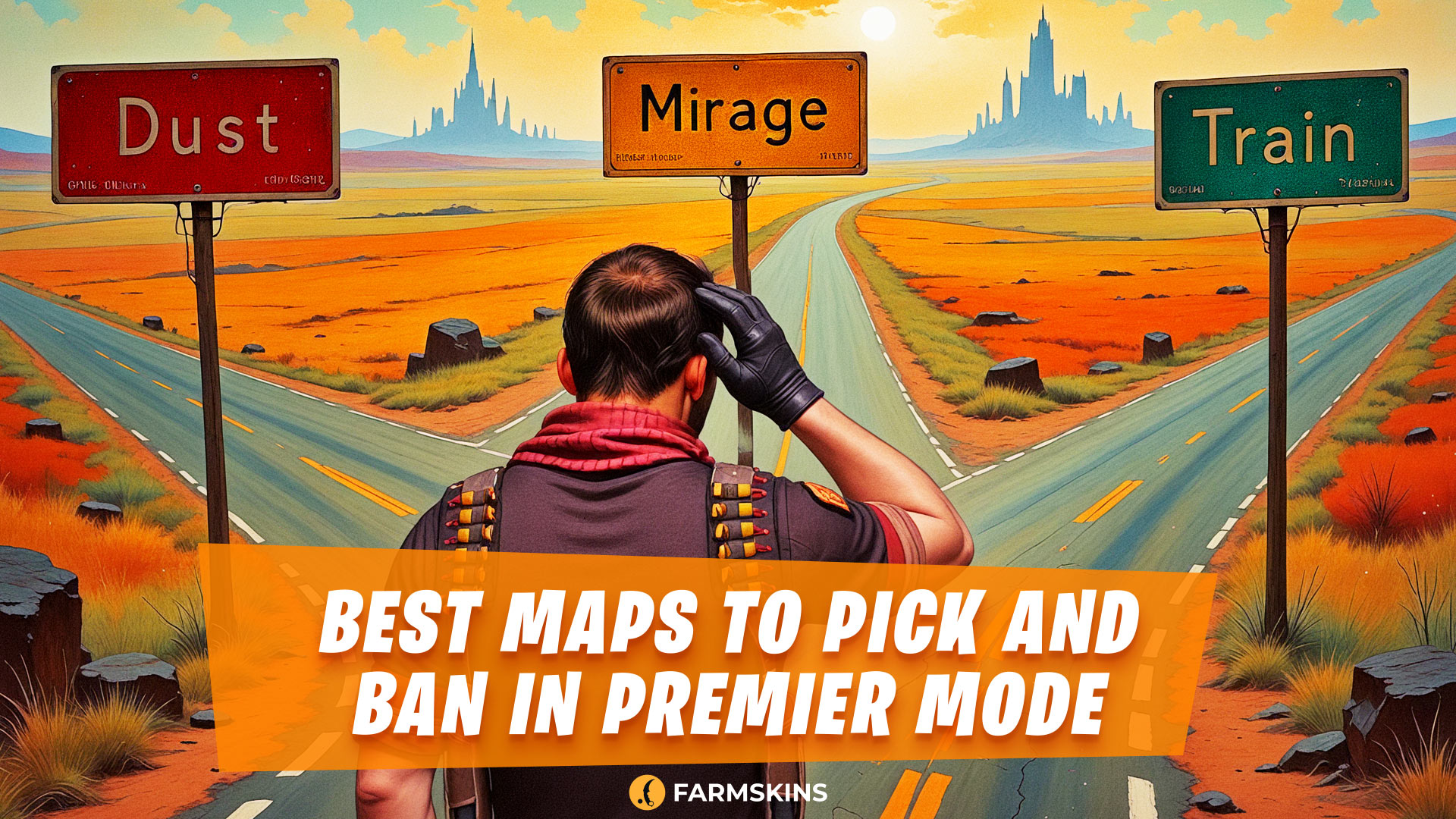
Premier Mode in CS2 is a ranked format with a mutual map pick/ban system before the match, similar to professional tournaments. As of November 2025, there are 7 active competitive maps (Ancient, Dust2, Inferno, Mirage, Nuke, Overpass, Train). When selecting maps, it’s important to consider win rates (side balance), player and team preferences, pick/ban frequency on the pro scene, and overall playability and balance. Below are the top 3 maps most advantageous to pick, and the top 3 maps often recommended to ban, along with strategic reasoning. At the end, you'll also find map veto strategy tips for Premier mode.
"1. Best Maps to Pick and Ban in CS2 Premier Mode","1.1. Top 3 Maps to Pick","1.2. Top 3 Maps to Ban","1.3. Map Pick/Ban Strategy Tips"
Top 3 Maps to Pick
1. Mirage
Mirage is one of the most universal and balanced maps in CS2. It remains iconic and widely loved by both professionals and casual players. Mirage consistently ranks among the most popular maps both in matchmaking and on the pro scene. The map is close to perfectly balanced, with about 51% CT rounds vs. 49% T rounds in Premier matches, meaning the outcome is more about player skill than side advantage. Mirage offers a wide variety of strategies and roles: mid control is essential, both A and B sites offer multiple approaches, and there are many flanking options. The layout has been well-known to players since CS 1.6 and CS:GO, making most teams feel confident playing it. With its strategic flexibility, familiarity, and polished meta, Mirage is a reliable pick for almost any team.
2. Inferno
Inferno is another classic and highly balanced map. Win rate stats show a perfect 50/50 split between sides, making it a model of fairness. The iconic Banana on B and the narrow A site approaches define Inferno’s unique playstyle: it features tight close-range fights and demands strong utility usage. While the map requires coordination (e.g., taking Banana with flashes and molotovs), it also offers many options: fast rotates, tempo changes, and diverse tactics. Simple navigation and familiar structure allow players to adapt quickly during rounds. Though some pro teams avoid picking Inferno due to its universal familiarity, for most players it remains a safe and reliable choice. If your team understands how to play Inferno properly, it’s an excellent map to pick thanks to its side balance and tactical depth.
3. Ancient
Ancient is a relatively new map (introduced in 2021) that has proven to be well-balanced and strategic in CS2. Initially in CS:GO, Ancient favored CT sides and had an overly central B-site focus, but multiple updates from Valve have balanced the gameplay. Now, mid control is essential, and both sites see regular action. Professional data shows nearly 49% CT vs. 51% T win rates—remarkably balanced. In early 2025, Ancient even became the most played map among pro teams. Its success is due to solid layout and current meta: the map has a familiar three-lane architecture (often likened to a “green Dust2”) with active midplay and options for flanks. After lighting and skybox changes in CS2, utility and contact plays became even more accessible. Teams now center their play around controlling mid and splitting defenders. Ancient is flexible, supporting both slow executes and fast rushes. If your team has practiced Ancient, it’s an ideal pick—your opponents may be less prepared for it, and the side balance helps reduce random outcomes.
Note: Classic Dust2 (re-added to the pool in 2024) can also be considered a strong pick. Well-known and relatively balanced, Dust2 supports individual aim-heavy play. In early 2025, it was the 4th most played map in Premier. If your team is confident on Dust2, it remains a top-tier pick.
Top 3 Maps to Ban
1. Nuke
Nuke is a vertically structured, two-level map—A and B sites are stacked above each other. It’s strategically complex, requiring excellent coordination. Defense must watch numerous routes (vents, door, outside, ramp), while offense has to clear many angles. The map is compact and filled with tight corridors, encouraging close-range duels and heavy utility usage. Historically, Nuke has been strongly CT-sided; although CS2 data has shown some increase in T-side success, the map remains challenging and demanding. Without dedicated practice, most teams find it difficult to coordinate attacks or handle the upper/lower dynamic. Many players struggle with radar readability, vertical callouts, and site transitions. Unless your team has strong protocols, it’s better to ban Nuke early and avoid complications.
2. Train
Train returned to the active map pool in 2025, and many teams are still adjusting to it. Known for long sightlines and strong CT setups, Train heavily favors defensive sniping and positioning. Historically, CT win rates were extremely high on this map. CS2 Train is still CT-favored, and success as Terrorists requires perfect smokes and entry coordination. Many casual teams lack the structured attack plans Train demands. As a result, Train is often banned. On the pro scene, it’s one of the least picked maps, and in Premier it’s often avoided due to layout complexity (trains, ladders, angles). If your team lacks deep preparation, ban Train—otherwise, you risk giving opponents a significant edge.
3. Overpass
Overpass is a large, tactical map with unusual spawn positions and long rotations. Terrorists spawn closer to B, while pushing A requires a long route through Park and Long. The map demands aggressive CT info-gathering, as defenders risk losing map control quickly. While Overpass was iconic in CS:GO, in CS2 it underwent reworks before returning to the pool in mid-2025. Side balance is questionable: early CS2 stats showed a T-side advantage, which puts unprepared CT teams in a tough position. For many players, Overpass is unfamiliar and overwhelming: its size enables opponents to run fakes, rotate freely, and isolate defenders. In solo queue, teammates often don’t know grenades or timings, making Overpass chaotic and risky. Unless your team practices it regularly, it’s often best to ban Overpass.
Historical Note: Prior to the current rotation, Vertigo and Anubis were the most commonly banned maps. Valve eventually removed them from the pool (Vertigo in early 2025, Anubis mid-2025). Vertigo was disliked for its verticality and unpredictable angles, while Anubis had a clear T-side bias. These examples show how poor balance or confusing layouts can make a map unpopular. With these maps gone, bans now focus more on Nuke, Train, and Overpass.
Retakes Mode in Counter-Strike 2
Map Pick/Ban Strategy Tips
1. Know Your Team’s Strengths and Weaknesses
Before the match, honestly assess your team’s weakest map—and ban it first. For example, if you consistently lose on Nuke or Train, remove it immediately. Conversely, make sure to keep maps you’re comfortable on in the pool. Premier Mode allows play on any of the seven maps, but most teams have 2–3 preferred ones. Focus on getting the final choice to be one of your strongest maps.
2. Use Opponent Data
During map veto, CS2 shows info: red for maps your opponents recently won, and gray for your team’s wins. Pay attention. After removing your worst map, target maps the enemy team likes based on their win history. For instance, if opponents often win on Mirage or Inferno, remove at least one. This limits their comfort zone and increases your chances of a neutral or favorable matchup. While you can’t always predict strangers’ preferences, this info is a key advantage—don’t ignore it.
3. Consider Final Side Selection
At the final stage—when 2 maps remain—the Blue team picks the map, and the Red team picks the side (CT or T).
If you’re Blue (you pick the map): Try to make sure the remaining maps are balanced, like Mirage or Ancient. Avoid leaving in heavily one-sided maps unless you're confident. For example, if Nuke or Train remains, the Red team will likely take CT side, putting you on the difficult T start. So it's wise for Blue teams to ban one-sided maps earlier.
If you’re Red (you pick side): You can flip the logic—let a slightly skewed map through and take its stronger side. For instance, on Overpass, start T to capitalize on early momentum. Or on Nuke, start CT and build a lead. Side choice can swing several rounds in your favor—use it strategically.
4. Communicate and Stay Flexible
In Premier Mode, map bans are decided by team vote. Make sure everyone is aligned. Suggest a plan (which map to ban, which to leave) in chat or voice before the match starts. If you play with a squad, assign one person to lead veto strategy. Also, have backup options: sometimes enemies ban your favorite maps, forcing you onto second-tier choices. Prepare by learning key smokes, flashes, and positions on every map. That way, even if your top picks are gone, you won’t be lost. Premier is about adaptability: the ability to steer veto toward your comfort maps while denying opponents their strengths is what wins games.
By following this advice, you’ll be able to build a smart pick/ban strategy and improve your chances of winning in CS2 Premier mode.
.jpg)
.jpg)
.jpg)
.jpg)
.jpg)
.jpg)
.jpg)
.jpg)

.jpg)
.jpg)
.jpg)
.jpg)


.jpg)
.jpg)
.jpg)
.jpg)
