CS2 Terminology Guide: Key Terms Every Player Should Know

CS2 Terminology Guide: Key Terms Every Player Should Know
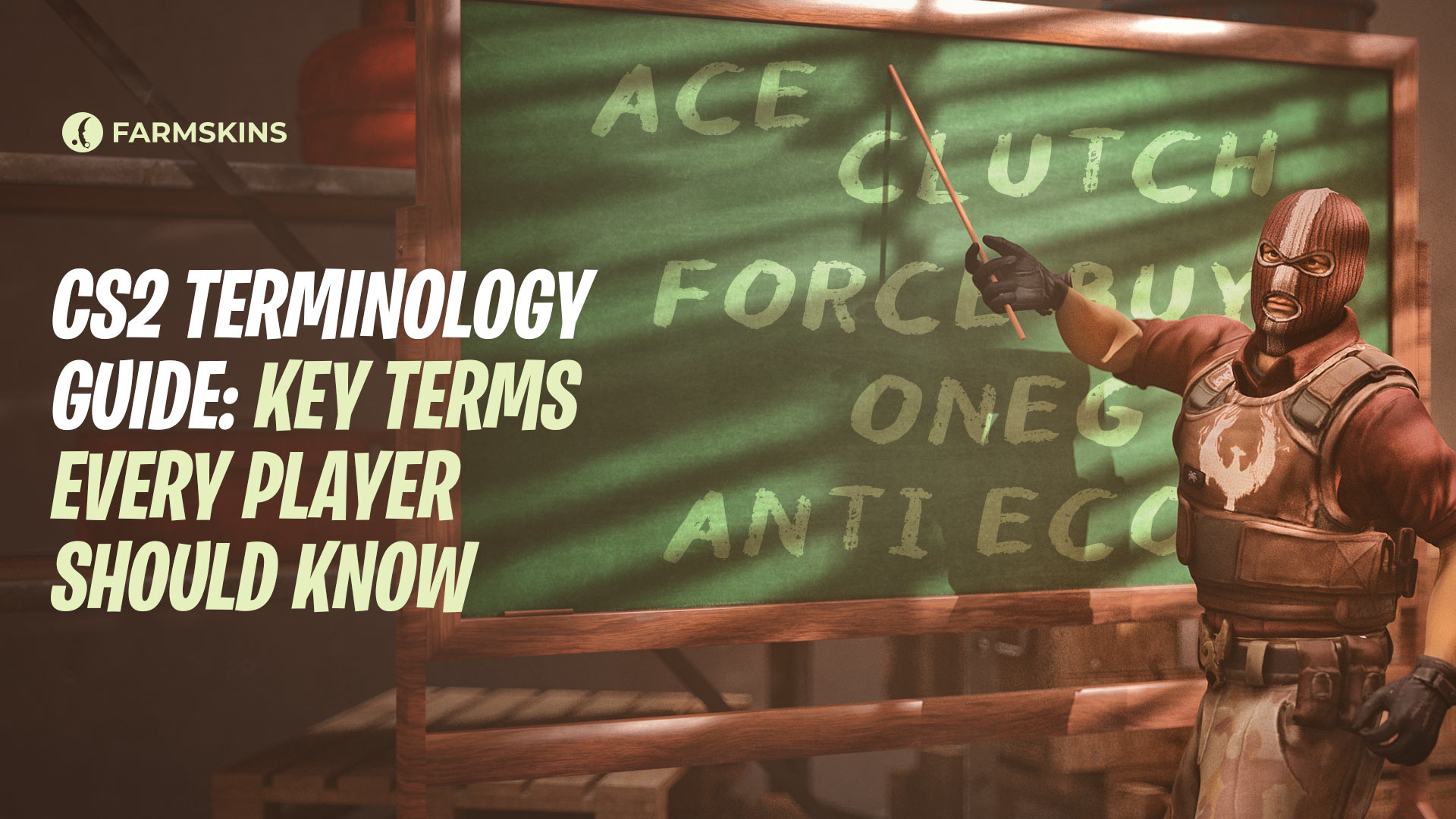
Counter-Strike 2 (CS2) is a tactical FPS where effective communication is key to success. Knowing the game’s terminology helps new players understand strategies, coordinate with teammates, and elevate their gameplay. This CS2 guide covers essential CS2 terms, making it easier for you to jump into the action confidently.
"1. CS2 Terminology Guide: Key Terms Every Player Should Know","1.1. Kill Terminology","1.2. Tactical CS2 Terms","1.3. Economy Terms","1.4. Utility and Combat"
Kill Terminology
-
Ace: Achieved when one player eliminates the entire enemy team, even if the team has fewer than five players.
-
Collateral (Cal): When one bullet kills two enemies simultaneously.
-
Lit: Indicates an enemy has taken damage, e.g., “lit for 70” means they have 70 HP left.
-
Dink: A headshot that doesn’t kill the enemy, named after the sound it makes when hitting a helmet.
-
Clutch: Winning a difficult situation, like being the last player alive against multiple enemies.
-
Entry Frag: The first kill in a round that opens a path to an area or bomb site.
-
Pick: An isolated kill that disrupts the enemy’s plans, often enabling a strategic advantage. Unlike an entry frag, a pick can happen at any point in the round.
Entry Fragger in CS2: The Role of the Aggressive Opener
Tactical CS2 Terms
-
Camping: Holding a single position for an extended time to catch enemies off guard, e.g., “Camp Underwood.”
-
Boost/Run Boost: Using a teammate to reach otherwise inaccessible positions. A run boost involves momentum from running.
-
Rotate: Moving between areas to adjust to enemy actions, e.g., “Rotating from B to A.”
-
Split Push: Attacking a site from multiple directions simultaneously, like two players attacking from Ramp and two from Palace on Mirage.
-
Stack: Concentrating multiple players in one area, often during a low-buy round to surprise the enemy.
-
Rush: A fast and overwhelming attack to catch defenders off-guard, e.g., “Rush A means go fast, no slowing down.”
-
Contact Play: Slowly approaching a site without utility to avoid detection until the enemy engages.
-
Info Play: Gaining information on enemy positions or utility use without necessarily committing to an attack.
-
Crossfire: Coordinating angles with a teammate to cover an area from two directions, forcing enemies into a disadvantageous fight.
-
Map Control: Dominating specific areas of the map to limit enemy movement and gain strategic advantage.
-
Post-Plant: The positioning and tactics used after planting the bomb, focusing on defending it until detonation.
Economy Terms
-
Economy: The team’s available money for purchasing weapons, armor, and utility.
-
Eco/Full Eco: Saving money by buying minimal equipment (Eco) or nothing at all (Full Eco) to afford better gear in future rounds.
-
Full Buy: Purchasing full armor, primary weapons, and utility to maximize chances in the round.
-
Half Buy/European Buy: A mix of spending; some players buy rifles while others save for future rounds.
-
Force Buy: Spending all available money, even if it means buying suboptimal gear, in an attempt to surprise the enemy.
-
Anti-Eco: Purchasing weapons that maximize monetary rewards (e.g., SMGs) to exploit an enemy team expected to be on an Eco round.
-
Loss Bonus: Extra money awarded to a team losing consecutive rounds, capped after five rounds.
-
Save: Retreating to preserve weapons and utility for the next round instead of risking them in a lost situation.
-
Glass Cannon: Buying a powerful weapon, such as an AWP, without armor due to limited funds, trading protection for firepower.
Utility and Combat
-
Anti-Flash: Turning away from an expected flashbang to avoid being blinded while holding an angle.
-
Flash Peek: Peeking immediately after a teammate flashes to catch blinded enemies.
-
Fake Flash: Throwing a pistol or grenade to mimic a flashbang, tricking enemies into turning away.
-
Jiggle Peeking: Rapidly stepping in and out of cover to gather information without exposing yourself for too long.
-
Wide Peek: Fully stepping out of cover to catch enemies off-guard, trading safety for aggression.
-
Pop Flash: A flashbang that detonates close to the target, blinding them instantly.
-
Oneg: Accidentally dying to your own incendiary grenade or Molotov, named after a famous player’s mishap.
-
Jump Spot: Jumping behind cover to quickly check for enemies without fully exposing yourself.
-
Stick: Committing to an action, such as defusing the bomb, without stopping despite the risk.
Understanding CS2 terminology is essential for effective communication and strategy in the game. By familiarizing yourself with these terms, you’ll not only improve your gameplay but also connect better with your teammates. Start using these terms and see your confidence in matches grow!


